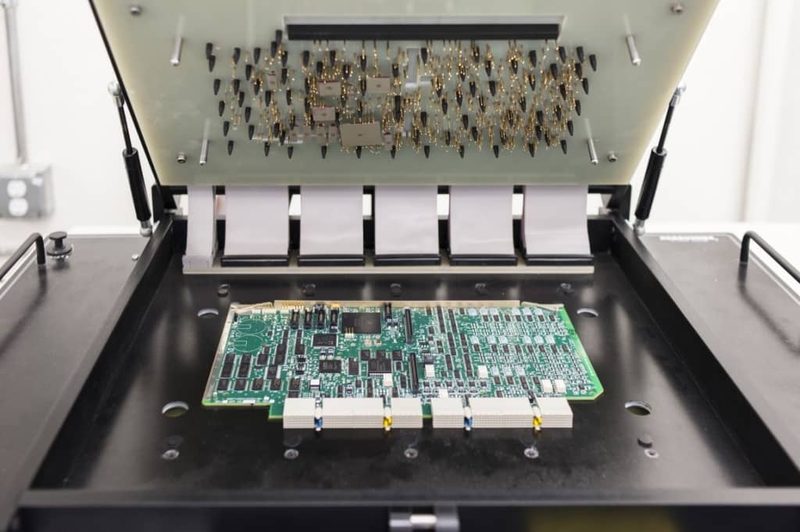
One of the most common questions we receive from manufacturers evaluating a new SMT production line is: "Do we need ICT, FCT, or both?" The answer depends on your product requirements, industry standards, and quality objectives — but for most serious manufacturers, the answer is both. Here's why.
What is ICT (In-Circuit Testing)?
In-Circuit Testing, commonly abbreviated as ICT, is a static testing method that verifies the electrical integrity of individual components and connections on a PCB without powering the circuit. Using a bed-of-nails fixture with spring-loaded pins that contact specific test points, ICT measures resistance, capacitance, inductance, and voltage at each node to confirm that every component is correctly placed, properly soldered, and within specification.
Think of ICT as a detailed component-level audit. It checks whether each individual part is correct and properly connected, but doesn't verify whether the overall circuit actually functions as designed.
What is FCT (Functional Circuit Testing)?
Functional Circuit Testing, or FCT, takes a fundamentally different approach. Instead of checking individual components in isolation, FCT powers up the board and tests whether it performs its intended function correctly. The test system applies real input signals and measures the actual output responses, verifying that the complete circuit operates as specified.
If ICT is a component audit, FCT is a performance exam. It confirms the board works as a complete system, regardless of whether individual components are technically within specification — as long as the overall function is correct.
Side-by-Side Comparison
| Aspect | ICT (In-Circuit Test) | FCT (Functional Test) |
|---|---|---|
| Test Approach | Static — tests without power | Dynamic — tests with power applied |
| What It Detects | Wrong values, missing parts, opens, shorts, misoriented components | Functional failures, timing issues, firmware bugs, signal integrity problems |
| Test Level | Component-level verification | System-level verification |
| Fixture Cost | Higher (precision bed-of-nails) | Variable (depends on complexity) |
| Programming Effort | Moderate (component database) | Higher (functional simulation) |
| Cycle Time | 15-45 seconds typical | 20-60 seconds typical |
| Defect Coverage | Excellent for manufacturing defects | Excellent for functional defects |
| Best For | Catching assembly errors early | Verifying end-product performance |
Why You Need Both ICT and FCT
The most effective quality strategy in SMT manufacturing uses ICT and FCT as complementary layers of defense against different types of defects. Here's why relying on just one method leaves gaps:
What ICT Catches That FCT Misses
- A 10kΩ resistor installed where a 100kΩ should be (value still "works" but circuit drifts over temperature)
- A capacitor with 5% drift that's technically functional but out of tolerance
- A solder joint that's marginal — functional now but will fail after thermal cycling
- Wrong component orientation that only causes failure under specific conditions
What FCT Catches That ICT Misses
- Firmware bugs in programmed microcontrollers
- Timing issues between components that only appear during operation
- Signal integrity problems under real-world loading conditions
- Communication protocol failures between ICs
Together, ICT and FCT provide comprehensive coverage that neither method can achieve alone. ICT catches the manufacturing defects that could cause field failures down the road, while FCT verifies that the product actually works as intended before it ships to customers.
How Keli's SMT Line Integrates Both
In Keli Automation's 7-station SMT production line, ICT is positioned at Station 2 and FCT at Station 3, creating a sequential quality gate system. This arrangement provides several advantages:
Sequential Testing Benefits
- Early defect detection: ICT catches assembly errors before FCT, preventing wasted test time on fundamentally defective boards
- Accurate fault diagnosis: When FCT fails, knowing ICT passed means the problem is likely functional rather than assembly-related
- Optimized throughput: Boards that fail ICT are diverted immediately, preventing them from occupying the FCT station
- Complete data trail: Both test results are logged per-board for full traceability and SPC analysis
The integrated production line uses Mitsubishi PLC controllers to coordinate test sequencing, Advantech industrial PCs for data collection and analysis, and Omron sensors for board positioning accuracy. This combination of industry-leading brands ensures consistent test reliability and repeatable results across production runs.
Making the Decision for Your Production
Not every manufacturer needs both ICT and FCT at full complexity. Consider these factors:
You Need ICT If:
- Your customers require component-level traceability documentation
- You produce high-mix, low-volume products where manual inspection is impractical
- You're manufacturing for automotive, medical, or aerospace applications
- Your defect rate from assembly processes needs early-stage detection
You Need FCT If:
- Your products contain programmable components (microcontrollers, FPGAs)
- Functional performance verification is critical to customer satisfaction
- You need to verify communication interfaces and protocols
- Your product specifications require powered performance testing
You Need Both If:
- You want comprehensive defect coverage (99%+ first-pass yield target)
- Your industry requires both component and functional verification
- You're building an automated SMT production line for long-term competitive advantage
- You need complete data logging for quality management and regulatory compliance
Discuss Your Testing Requirements
Keli Automation's engineering team can help you determine the optimal testing configuration for your specific products and quality requirements. Our SMT production lines integrate both ICT and FCT seamlessly.
Get Expert Advice📞 (+86) 400-076-9629 | ✉️ info@e-kli.com