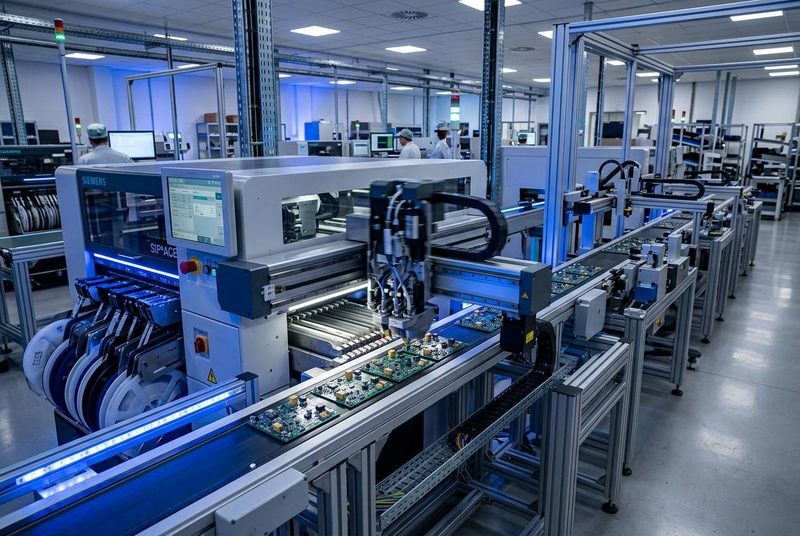
In the rapidly evolving landscape of electronics manufacturing, post-reflow SMT automation has emerged as a critical technology for companies seeking to optimize their production efficiency while maintaining superior quality standards. If you've been exploring ways to modernize your SMT production line, understanding post-reflow automation is essential for making informed investment decisions.
What is Post-Reflow SMT Automation?
Post-reflow SMT automation refers to the automated processes that occur after surface mount components have been soldered to a PCB through the reflow oven. Once the solder joints have solidified during the cooling phase of reflow soldering, the PCB board enters the post-reflow stage where it undergoes various testing, inspection, and processing operations before becoming a finished product.
Traditional manufacturing approaches often rely heavily on manual handling and inspection at this stage, which introduces variables that can compromise product quality and throughput. Post-reflow automation eliminates these inconsistencies by implementing precisely controlled mechanical systems and automated testing protocols that operate with remarkable repeatability.
The automation workflow typically includes In-Circuit Testing (ICT) to verify individual component functionality, Functional Circuit Testing (FCT) to confirm overall circuit performance, automated dispensing for thermal interface materials or protective coatings, board flipping operations for dual-sided processing, depaneling or routing operations to separate individual units from panel arrays, and robotic handling for packaging or integration into subsequent assembly stages.
Key Benefits of Post-Reflow Automation
- 40% improvement in production throughput compared to manual processing
- 99.2% first-pass yield rate through automated inspection
- Complete traceability with data logging for every board
- Reduced labor costs with 60% fewer operators required
- Consistent quality eliminating human error factors
Why Automate Your Post-Reflow Process?
The decision to implement post-reflow automation stems from several compelling business imperatives that affect both immediate operational metrics and long-term competitive positioning. Understanding these drivers helps manufacturers evaluate whether automation investment aligns with their strategic objectives.
Quality Assurance Imperatives
Modern electronics assemblies contain increasingly complex circuitry with components that demand precise electrical verification. Manual testing approaches struggle to achieve the coverage and accuracy necessary for today's demanding applications, particularly in automotive, medical, and industrial control sectors where failure consequences are severe.
Automated ICT systems can test hundreds of electrical nodes in seconds, identifying opens, shorts, missing components, and incorrect values with far greater reliability than visual or manual probing methods. Similarly, automated FCT systems simulate real-world operating conditions to verify that assembled boards function correctly before shipment to customers.
Economic Considerations and ROI
While initial capital investment in automated equipment represents a significant commitment, the return on investment typically materializes within 18-24 months for moderate-volume production facilities. Consider the economics: a single manual operator can typically handle 60-80 boards per hour, whereas an automated line can process 200-300 boards with minimal human intervention. At current labor rates and projected increases, automation economics become increasingly favorable.
Projected ROI Analysis
The 7-Station Post-Reflow Process Flow
A comprehensive 7-station SMT production line provides a balanced workflow that addresses all critical post-reflow requirements while maintaining efficient cycle times. Each station serves a specific function in the overall quality and processing chain.
7-Station Process Overview
Manual Board Loading
ICT In-Circuit Test
FCT Functional Test
Automated Dispensing
Board Flip & Mark
Auto Depaneling
Robotic Unloading
Station-by-Station Breakdown
Station 1: Manual Board Loading — Operators load PCBs from incoming magazine racks onto the production line's conveyor system. This station provides a quality checkpoint for incoming boards and allows for manual programming or fixture changes between product types.
Station 2: ICT In-Circuit Testing — Using bed-of-nails fixtures, the ICT system verifies the electrical integrity of each component on the board. This catches component placement errors, solder defects, and component value issues before further processing.
Station 3: FCT Functional Testing — Boards undergo functional verification where they are powered and tested under conditions simulating actual operation. This confirms that the assembled board performs its intended function correctly.
Station 4: Automated Dispensing — Precision dispensers apply thermal interface materials, conformal coatings, or structural adhesives as required by product specifications. Automation ensures consistent dispense volume and placement accuracy.
Station 5: Board Flip and Marking — Boards are automatically flipped for access to the secondary side, and identification marks or labels may be applied. This station handles any dual-sided processing requirements.
Station 6: Automated Depaneling — Individual boards are separated from panel arrays using routing, v-scoring, or punching methods. Automation ensures clean edges and precise separation without damaging components.
Station 7: Robotic Unloading — Finished boards are unloaded by robotic systems into outgoing magazine racks or directly into packaging. Vision systems verify proper placement and any final visual inspection criteria.
Industry Applications and Use Cases
Post-reflow SMT automation serves diverse industry segments, each with specific quality and throughput requirements that shape optimal configuration choices.
Consumer Electronics Manufacturing
High-volume consumer products demand maximum throughput with competitive per-unit costs. Automation configurations emphasize speed and efficiency while maintaining quality levels appropriate for consumer applications.
Automotive Electronics
Automotive applications require rigorous testing and traceability documentation that automated systems excel at providing. ICT and FCT testing parameters are typically more stringent, and complete production records must support defect analysis and warranty tracking requirements under IATF 16949 standards.
Medical Device Manufacturing
Medical device PCBs demand the highest levels of quality assurance and documentation. Every board must be fully traceable from component level through final functional verification, making automated testing and data logging essential for regulatory compliance.
Industrial Control Systems
Industrial controllers and power electronics require thorough functional testing under various load conditions. Automated FCT systems can simulate real-world operating scenarios that would be impractical to perform manually at production volumes.
Key Technology Components
Modern post-reflow automation lines integrate components from leading manufacturers to ensure reliability and precision. At Keli Automation, our production lines feature SMC pneumatic components for precise actuation, Mitsubishi PLC controllers for reliable logic processing, Advantech industrial PCs for data management, and Omron and Keyence sensors for accurate detection. Panasonic servo motors drive conveyor and positioning systems with exceptional accuracy.
Getting Started with Post-Reflow Automation
Transitioning to automated post-reflow processing requires careful planning and partner selection. Key steps include auditing your current production bottlenecks, defining quality and throughput requirements, evaluating available floor space, and selecting an experienced equipment supplier who can provide turnkey solutions.
Keli Automation offers comprehensive consultation services to help manufacturers design the optimal post-reflow automation configuration for their specific products and volume requirements. Our engineering team works closely with clients from initial assessment through installation and ongoing support.
Ready to Automate Your Post-Reflow Process?
Keli Automation's engineering team is ready to help you design and implement a post-reflow SMT automation solution tailored to your manufacturing needs.
Get a Free Consultation📞 (+86) 400-076-9629 | ✉️ info@e-kli.com