Introduction
When manufacturing electronic assemblies, the final separation of individual printed circuit boards (PCBs) from a larger panel represents one of the most critical steps in production. The method chosen for this PCB separation process directly impacts product quality, production efficiency, and overall manufacturing costs. Selecting the appropriate PCB depaneling machine is therefore a strategic decision that every electronics manufacturer must approach with careful consideration.
The global electronics manufacturing services (EMS) industry continues to evolve rapidly, with increasing demands for miniaturization, precision, and reliability. Whether you are producing consumer electronics, automotive components, medical devices, or industrial control systems, the separation technique you employ can determine whether your products meet stringent quality standards or suffer from defects that lead to costly failures.
This comprehensive guide examines the three primary depaneling technologies available in today's market: laser depaneling, router (CNC) depaneling, and score break (V-scoring) methods. By understanding the strengths and limitations of each approach, procurement managers, production engineers, and plant directors can make informed decisions when investing in PCB cutting machines and depaneling solutions.
Why PCB Depaneling Matters
The Critical Role of Panel Separation
Modern PCB manufacturing typically processes multiple boards in a single panel format. This approach maximizes the efficiency of surface mount technology (SMT) assembly lines, reduces handling time, and optimizes the use of expensive pick-and-place equipment. However, once assembly is complete, these individual boards must be separated cleanly and precisely.
Poor depaneling practices can introduce a range of problems that compromise product reliability:
Mechanical Stress and Damage: Traditional methods that apply excessive force during separation can generate micro-cracks in the board material or damage sensitive electronic components positioned near the edges. These hidden defects often escape visual inspection but may manifest as field failures months after the product reaches the end user.
Thermal Damage: Some separation methods generate heat that can affect solder joints, adhesive bonds, or temperature-sensitive components. In an era where lead-free solder processes and thermally sensitive microelectronics are standard, thermal management during depaneling has become increasingly important.
Dimensional Accuracy: As electronic devices shrink and component densities increase, the tolerances for edge clearance and board dimensions have tightened significantly. Inaccurate separation can render assembled boards non-functional or require expensive rework.
Contamination: Debris generated during the cutting or separation process can contaminate the board surface, potentially causing short circuits or reliability issues in the finished product.
Cost Implications
The choice of depaneling technology affects not only initial capital expenditure but also ongoing operational costs. A machine with a lower upfront cost may prove more expensive over time due to higher consumable expenses, reduced throughput, increased defect rates, or excessive maintenance requirements. Forward-thinking manufacturers evaluate total cost of ownership (TCO) rather than focusing solely on purchase price.
Three Main Depaneling Technologies Compared
Laser Depaneling
Laser depaneling represents the most advanced separation technology currently available for PCB manufacturing. This method employs high-precision laser systems to cut through the panel material without physical contact, utilizing focused light energy to vaporize or ablate the substrate along predetermined paths.
How It Works
Laser PCB depaneling machines direct a focused beam, typically from a CO2 or fiber laser source, along the designated separation lines. The laser's energy rapidly heats and vaporizes the material, creating a narrow kerf with exceptional precision. Modern systems incorporate computer-controlled positioning stages that achieve positioning accuracies measured in microns.
Key Advantages
The non-contact nature of laser processing eliminates mechanical stress on the board and surrounding components. This characteristic makes laser depaneling particularly valuable for:
- Flexible printed circuits (FPC): Laser cutting handles thin, flexible materials without deformation or damage that contact methods often cause.
- Dense component layouts: When components are positioned close to separation lines, laser technology avoids the tool clearance issues that constrain mechanical methods.
- Complex geometries: Laser systems can execute arbitrary cutting paths, including curves and intricate shapes, without tool changes or specialized fixtures.
- Minimal heat-affected zones: Contemporary laser systems with proper parameter control minimize thermal impact on adjacent areas.
- No tool wear: Unlike mechanical cutting methods, lasers do not require consumable cutting tools, eliminating tool replacement costs and downtime.
Limitations
- Higher initial investment compared to mechanical methods
- Processing speed may be slower for simple rectangular separations
- Some laser systems require exhaust ventilation for vapor extraction
- Certain board materials may not be suitable for laser processing
Router (CNC) Depaneling
Router-based PCB depaneling machines utilize rotating cutting bits mounted on computer-controlled motion systems to mechanically remove material along separation paths. This technology has served the industry for decades and remains popular for many applications.
How It Works
A spindle motor drives a specialized router bit at high rotational speeds while the motion system moves the bit along programmed paths. The router bit removes material progressively, creating a cut channel. Dust collection systems capture the generated debris, which typically consists of small particles of board material and any coating or plating.
Key Advantages
Router technology offers several compelling benefits:
- Established reliability: Decades of industrial use have refined router systems to a high degree of reliability and predictability.
- Cost-effective for high volumes: Lower machine costs and reasonable consumable expenses make routers economical for large production runs.
- Versatile material handling: Routers can process a wide range of board materials, thicknesses, and configurations.
- Visible processing: Operators can observe the cutting process directly, which some facilities prefer for quality monitoring.
- Faster for straight cuts: When cutting simple rectangular boards from panels, routers typically achieve higher throughput than laser systems.
Limitations
- Mechanical contact generates vibration and stress that can affect sensitive components
- Tool wear requires regular bit replacement and tolerance verification
- Bit deflection can affect cut accuracy, particularly with longer tool engagement
- Complex curved paths require specialized programming and may experience reduced precision
- Dust and debris require active extraction and cleaning procedures
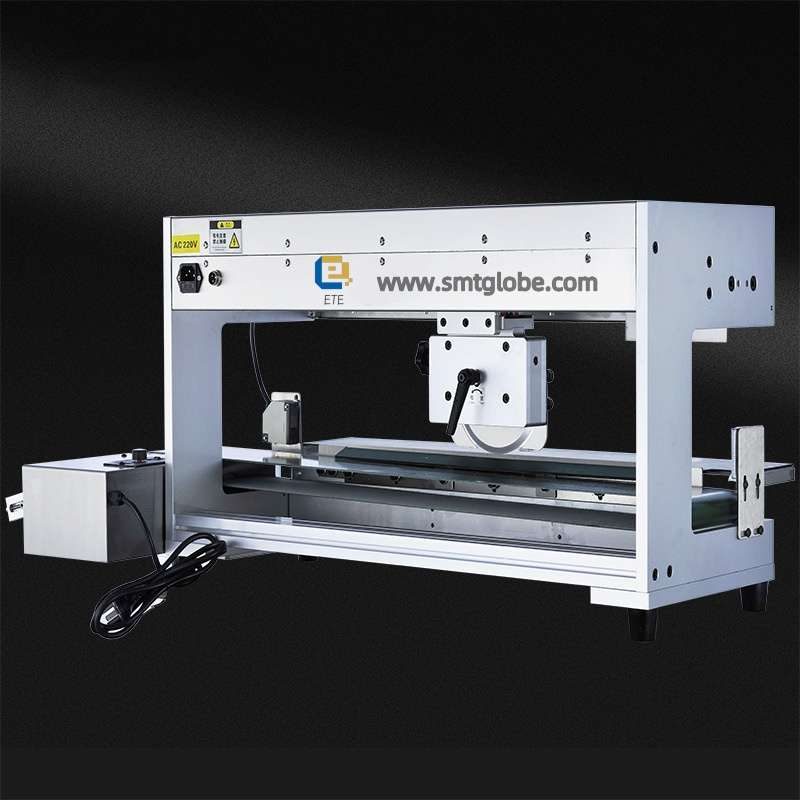
Score Break (V-Scoring) Depaneling
V-scoring represents the simplest and most economical approach to PCB separation. This method involves cutting partial-depth grooves (V-shaped channels) into the panel during fabrication, with the board subsequently separated by applying manual or mechanical force along the scored lines.
How It Works
During PCB fabrication, a specialized saw blade cuts V-shaped channels from both sides of the panel to a controlled depth that leaves sufficient material intact to maintain panel integrity. Once assembly is complete, operators or automated equipment apply controlled pressure to fracture the board along the weakened lines.
Key Advantages
- Lowest cost option: Minimal equipment requirements and no specialized machinery for separation
- High throughput potential: Break separation is extremely fast when properly configured
- Simple operation: Requires minimal training and technical expertise
- No consumables during separation: Only the initial panel fabrication involves scoring
Limitations
- Limited to straight-line separations only
- Requires pre-machined panels with V-scores
- Component placement must avoid scored areas with sufficient margin
- Stress during breaking can damage sensitive components near separation lines
- Less precise than other methods due to fracture propagation variability
- Not suitable for flexible circuits or thin materials prone to tear-out
Comparison Table: Laser vs Router vs Score Break
| Criteria | Laser Depaneling | Router Depaneling | Score Break |
|---|---|---|---|
| Initial Investment | High | Medium | Very Low |
| Processing Speed | Medium to Fast | Fast for straight cuts | Very Fast |
| Precision | Excellent (micron level) | Good | Moderate |
| Stress on Components | Minimal | Moderate | Variable |
| Complex Geometries | Full capability | Limited | None (straight lines only) |
| Flexible Circuit Support | Yes | Limited | No |
| Tool/Consumable Costs | Low | Medium | Low |
| Maintenance Requirements | Low to Medium | Medium | Very Low |
| Setup Flexibility | High (quick changeover) | Medium | Low (panel-dependent) |
| Best Suited For | Precision, complex layouts | High-volume, simple cuts | Simple, straight-line panels |
Selecting the Right Depaneling Solution
Production Volume Considerations
High-volume production runs favor technologies that minimize per-board processing time and reduce labor requirements. Router systems and V-scoring excel in these scenarios due to their fast cycle times and relatively simple operation. However, when high volumes involve complex board geometries or sensitive components, the defect rates associated with faster methods may offset their speed advantage.
Lower to medium volume production provides opportunities to leverage the flexibility and precision advantages of laser systems. The reduced setup times and elimination of tooling changes make laser depaneling increasingly competitive for batch sizes that previously would have defaulted to mechanical methods.
Board Complexity and Design
Board designs featuring curved edges, internal cutouts, or non-rectangular shapes necessitate laser technology. Router systems can accommodate some complexity but may require specialized programming and tooling. V-scoring remains limited exclusively to straight-line separations.
The proximity of components to separation lines represents a critical factor. Components located within 2-3mm of the depaneling path generally require non-contact methods to avoid damage from mechanical stress or thermal exposure.
Material Considerations
Standard FR-4 rigid boards handle most separation methods adequately. However, specialized materials including polyimide flexible circuits, aluminum-backed thermal boards, ceramic substrates, and high-frequency materials often respond better to laser processing or may require it exclusively.
Thin boards below 0.8mm thickness typically cannot withstand the mechanical stress of V-scoring or aggressive router parameters, making laser depaneling the appropriate choice.
Quality and Reliability Requirements
Products destined for automotive, medical, aerospace, or other high-reliability applications justify the investment in laser depaneling. The minimal stress, exceptional precision, and absence of debris contamination contribute to higher first-pass yields and improved long-term reliability.
Consumer electronics and other applications with less stringent quality thresholds may find router or V-scoring approaches perfectly acceptable, particularly when production economics favor lower equipment investments.
Future-Proofing Considerations
Electronics miniaturization trends continue to accelerate. Component packages shrink while board densities increase, placing ever-greater demands on separation precision. Investing in laser depaneling technology today positions manufacturers to handle evolving product requirements without equipment replacement.
Keli Automation: Advanced Laser Depaneling Solutions
Keli Automation has established itself as a leading manufacturer of precision laser PCB depaneling machines designed to meet the demanding requirements of modern electronics manufacturing. The company's product portfolio addresses the full spectrum of production needs, from prototype development through high-volume manufacturing.
KL-6040 Dual-Station Laser Depaneling System
The KL-6040 represents Keli Automation's flagship dual-station platform, engineered for maximum production efficiency. This system features two independent processing stations that enable continuous operation—while one station processes panels, operators load and unload the other station, minimizing non-productive time.
Key specifications include:
- Precision linear motor drives achieving positioning accuracy of less than 20 microns
- Fully enclosed safety enclosure with interlocked access panels
- Integrated smoke extraction and filtration systems
- User-friendly touch-screen interface with job management software
- Support for both CO2 and fiber laser sources depending on application requirements
- Auto-focus capability maintaining optimal focal position across varying panel thicknesses
The dual-station configuration makes the KL-6040 particularly suitable for medium to high-volume production environments where throughput optimization directly impacts profitability.
KL-5545 Single-Station Laser Depaneling System
For facilities requiring laser precision in a compact footprint, the KL-5545 single-station system delivers exceptional performance without the floor space requirements of dual-station configurations. This platform balances processing capability with operational simplicity.
Key features include:
- Robust gantry-style motion system for reliable long-term accuracy
- Optional rotary indexing table for multi-panel processing
- Compact enclosure design suitable for Class 1000 cleanroom environments
- Comprehensive data logging for process traceability and quality control
- Flexible fixturing options accommodating various panel sizes and configurations
- Competitive pricing positioning that makes laser technology accessible to smaller operations
Both systems benefit from Keli Automation's commitment to comprehensive customer support, including installation, training, application engineering, and responsive after-sales service. The company's applications team works directly with customers to optimize cutting parameters for specific board materials and designs.
Conclusion
Selecting the appropriate PCB depaneling machine requires careful evaluation of multiple factors including production volume, board complexity, component sensitivity, quality requirements, and budget constraints. While laser, router, and score break technologies each offer distinct advantages, the continued advancement of laser systems has expanded their applicability across an ever-wider range of manufacturing scenarios.
For manufacturers prioritizing precision, flexibility, and long-term competitiveness, laser depaneling technology represents an investment in production capability that will serve evolving product requirements for years to come.
Keli Automation welcomes the opportunity to discuss your specific depaneling challenges and demonstrate how our laser systems can improve your production outcomes. Our applications engineering team is available to evaluate your board designs and recommend optimal processing solutions.
Contact Keli Automation today
Email: info@e-kli.com
Our specialists will respond promptly to discuss your requirements and provide detailed information about our laser depaneling solutions.